
By Prof. Dr. Philipp Koellinger — Co-founder & CEO, DeSci Labs
Your coding AI can finally do real research
SciWeave is now a Model Context Protocol (MCP) server. Claude Desktop, ChatGPT, Codex, Cursor, Windsurf, and any other MCP-compatible client can search 300 million scientific works, generate grounded answers with real DOIs, and resume multi-session research threads — through tools that plug into whatever AI workflow you already use. Free to start, usage-based after.
See it in action
Why an MCP — and why now
Every scientist I know has hit the same wall with Claude or ChatGPT: you ask a research question, the answer reads beautifully, and then you check the citations — and half of them don't exist. The papers are invented. The DOIs resolve to nothing. The authors are a mashup of real names and plausible fiction.
That's not a prompt-engineering problem. It's a structural one: the model is answering from its training data, not from the literature. The fix is to give the AI a live, direct line into a real research index — which is exactly what the Model Context Protocol is for. MCP lets an AI call a tool, in the middle of a conversation, and use the result to ground its response.
The SciWeave MCP is that tool for science. It connects your AI to 300 million scientific works — peer-reviewed journal articles, preprints, conference papers, and other scholarly outputs — and returns citations that resolve to papers that actually exist. The AI stops guessing; it starts reading.
Five research workflows you can build today
The SciWeave server exposes three tools in its first version that we just launched. They're deliberately minimal, but they compose into workflows that were effectively impossible before. Here are five that our early users are already running.
1. Draft a grant or paper background with real citations
In Claude Desktop, you can now say:
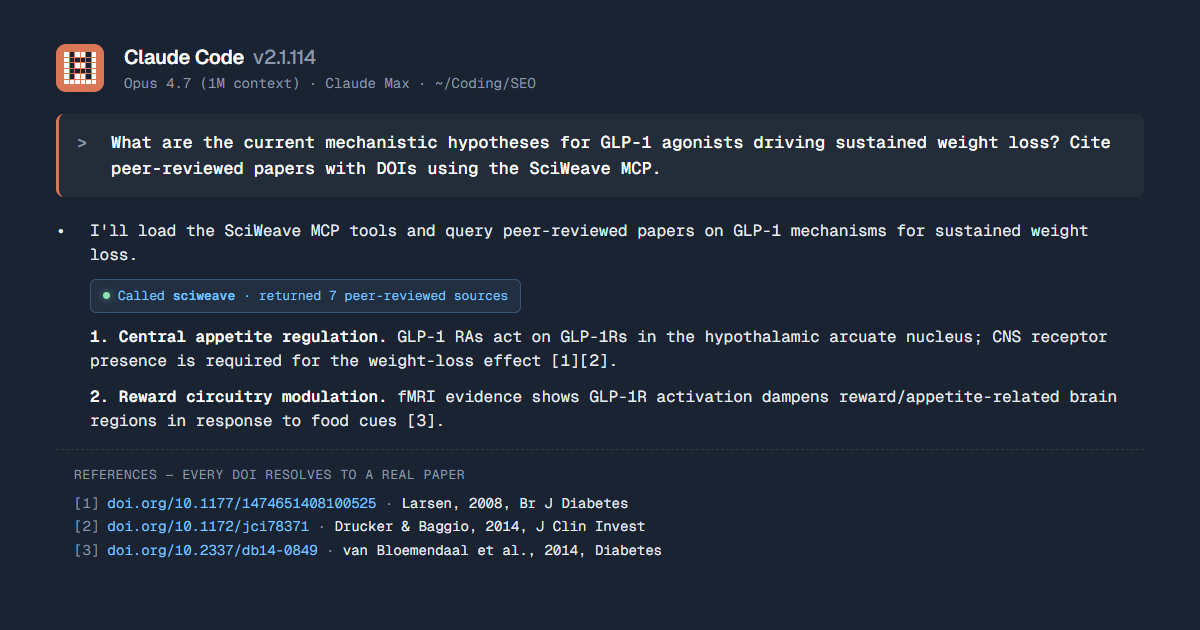
> "Draft a 300-word background section for a grant on GLP-1 agonists and sustained weight loss. Cover the current mechanistic hypotheses. Cite every claim with a real DOI — I'll verify."
Claude calls `ask_research_question`, pulls the current literature, and drafts a paragraph where every claim is tied to a verifiable DOI. No more scrubbing for invented references the night before submission.
2. Run a prior-art check before you design an experiment
> "Has anyone combined graph neural networks with cryo-EM data for de novo protein structure prediction? Cite anything from the last 10 years with a real DOI. If you find nothing, say so explicitly — don't guess."
Because the MCP queries the scientific corpus in real time, the answer is bounded by what is currently published in journals or on preprint servers — not by what the AI's training data happened to remember. A clean "no matches" is now a useful signal, not a failure mode.
3. Generate a ranked, cited reading list
> "Build me a starter reading list on CRISPR base editing from 2020 onward. Group by topic, rank by citation impact, one sentence on why each paper matters. Every DOI must be real."
Useful for onboarding a new team member, preparing a course, or figuring out where to start in a new research project. The AI does the curation; every row you see is verifiable.
4. Design a literature search strategy, then run an initial sweep
> "Help me design a search strategy for causal evidence on gut microbiome and depression. Propose the key boolean queries, year bounds, and paper filters. Then run an initial sweep and show me the top 5 results with real DOIs."
Systematic reviewers and meta-analysts tell us this is the single biggest time saver: the AI proposes the query logic, then validates it against the real corpus before you commit hours to a full sweep.
5. Resume a multi-session research thread
> "Resume my research thread on mRNA vaccine cold-chain logistics. Show me where we left off, what was already cited, and what's still open."
Every `ask_research_question` response returns a thread ID. Drop that ID into `get_research_thread` in tomorrow's session — or next week's — and you're back exactly where you left off, citations intact. Long literature reviews stop requiring one continuous marathon conversation.
Get your API key here: https://mcp.sciweave.com/
For agent builders: Codex, Claude Agent SDK, custom orchestrators
The three tools are standard MCP endpoints, which means anything that speaks MCP — the Claude Agent SDK, OpenAI Codex, Cursor, Windsurf, or your own orchestrator — can call them. Three patterns we're already seeing from teams building on top:
- RAG eval harness. Pipe `ask_research_question` into your golden-set to benchmark how well different models ground in live literature. Because every response includes DOIs, you can automatically score citation precision against ground truth.
- Long-horizon literature agent. Persist the returned `thread_id` across runs; resume with `get_research_thread`. Your agent keeps a coherent research memory over days or weeks without blowing the context window.
- Citation-verification step. Wrap `find_references` around any LLM output that mentions a DOI. If the DOI isn't in the SciWeave index, flag it. This single step catches hallucinated references before they hit a manuscript, policy brief, or grant application.
The three tools, and the one guarantee
-`ask_research_question` — returns a synthesized answer with inline citations grounded in SciWeave's paper index. Supports optional `min_year` / `max_year` filters.
- `find_references` — fast reference lookup. Returns titles, authors, year, DOI, URL, and abstract snippet for the top *k* most relevant papers. No AI synthesis; about one second typical latency.
- `get_research_thread` — retrieves a previous research conversation by its UUID, with the original question, answer, citations, and any follow-ups.
The guarantee is that every DOI returned resolves to a paper that actually exists. No fabricated authors, no fake 2019 *Nature* paper, no plausible-looking nonsense. If there's nothing in the literature, the tools will say so.
Install in 30 seconds
For Claude Desktop, paste this into your `claude_desktop_config.json` and restart:
```json
{
"mcpServers": {
"sciweave": {
"command": "npx",
"args": ["-y", "@sciweave/mcp"],
"env": { "SCIWEAVE_API_KEY": "your_key_here" }
}
}
}
```
ChatGPT, Codex, Cursor, Windsurf, and every other MCP-compatible client: point to the hosted endpoint at `https://mcp.sciweave.com` with your API key in the `Authorization` header. Full tabbed install instructions for every client live at sciweave.com/mcp.
Get your API key here: https://mcp.sciweave.com/
What's next
V1 ships with literature search, reference lookup, and research-thread persistence. The V1.1 roadmap adds personal collections — save papers across sessions, share them with collaborators — plus richer filtering and additional databases. If you're building AI agents for science and you have a tool request, hit reply or DM us. The whole point of the MCP is to let your AI do the research you want it to do; workflow feedback is how we prioritize.
Try it: sciweave.com/mcp — free to start, usage-based after. Pay only for the queries you run.
.svg)


.svg)
.svg)